

Last updated October 23, 2026. We update this page whenever PHP ships a new release, so the version numbers below are current as of that date.
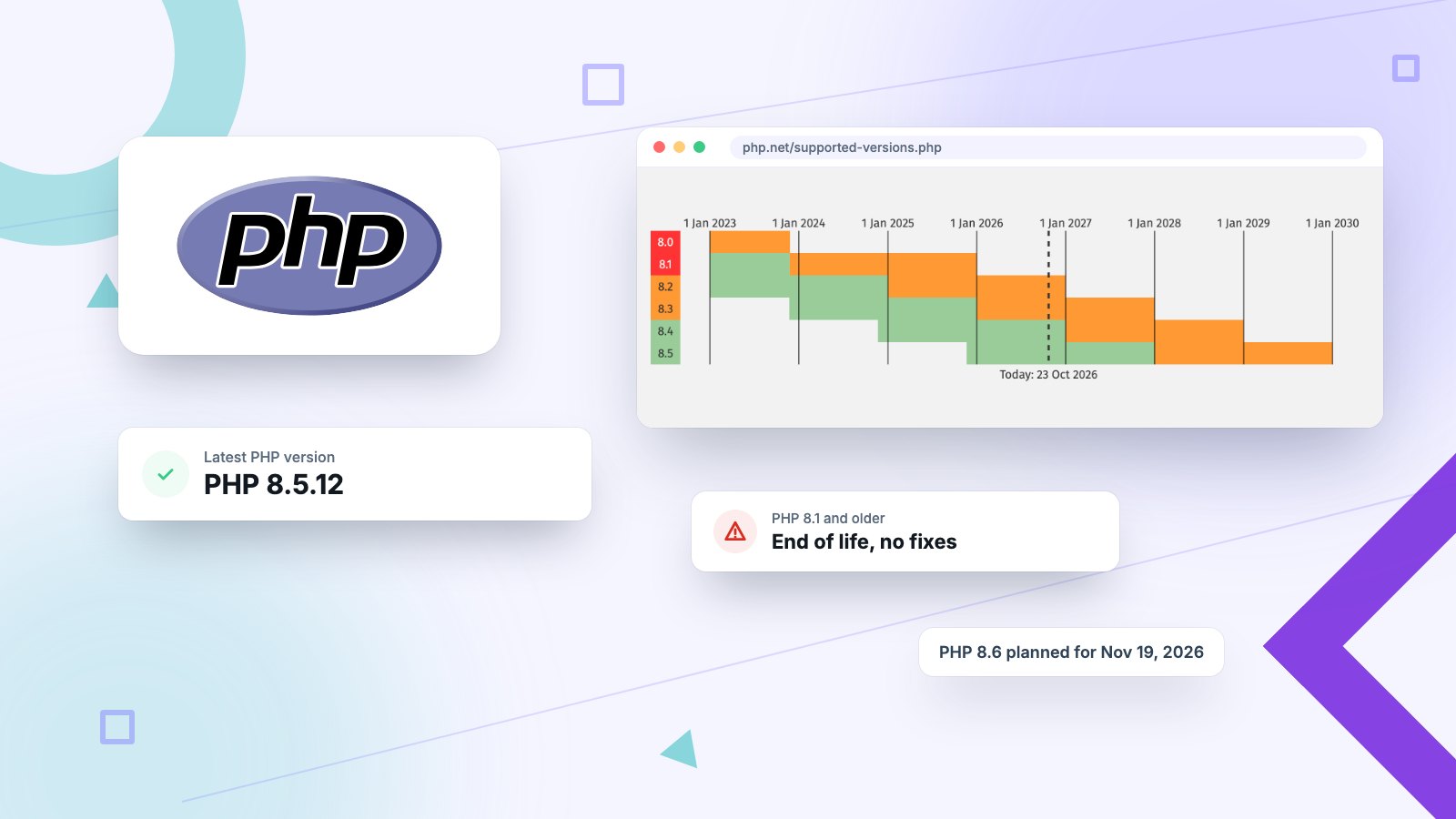
The latest PHP version is PHP 8.5.12, released on October 21, 2026. If you came here for the number, that’s it. You can close the tab and go about your day.
If you came here because a host, a plugin or a scary headline told you your PHP is out of date, stick around. Below is every PHP version still in use, when each one stops getting security fixes, which ones are already dead, and how to find out what your own website is running.
What is the latest PHP version?
The latest PHP version is PHP 8.5.12, released October 21, 2026. It’s the newest release of PHP 8.5, the most recent stable branch of PHP.
PHP 8.5.12 didn’t arrive alone. On the same day, the PHP team also released 8.4.27, 8.3.36 and 8.2.35. All four were emergency security releases that fix two critical flaws, nicknamed PHP2Shell, that can let an attacker run code on a web server without logging in. PHP’s own announcement says “all PHP users are strongly encouraged to update immediately.” We covered the vulnerability in detail in our PHP2Shell guide.
So “the latest PHP version” really has two answers:
- The newest branch: PHP 8.5, first released November 20, 2025.
- The latest release of the branch you’re on: 8.5.12, 8.4.27, 8.3.36 or 8.2.35. If you’re on PHP 8.3, for example, you don’t have to jump to 8.5 today. You do need 8.3.36.
The second answer matters more for most websites. Moving from 8.3 to 8.5 is a project. Moving from 8.3.35 to 8.3.36 is a patch, and a good host installs it for you without being asked.
On October 23, PHP also posted a follow-up advisory about a separate, much less likely attack path (CVE-2026-115560) and said the full fix will come “with the next release.” So expect another round of point releases soon. When it lands, we’ll update the numbers here.
Which PHP versions are still supported?
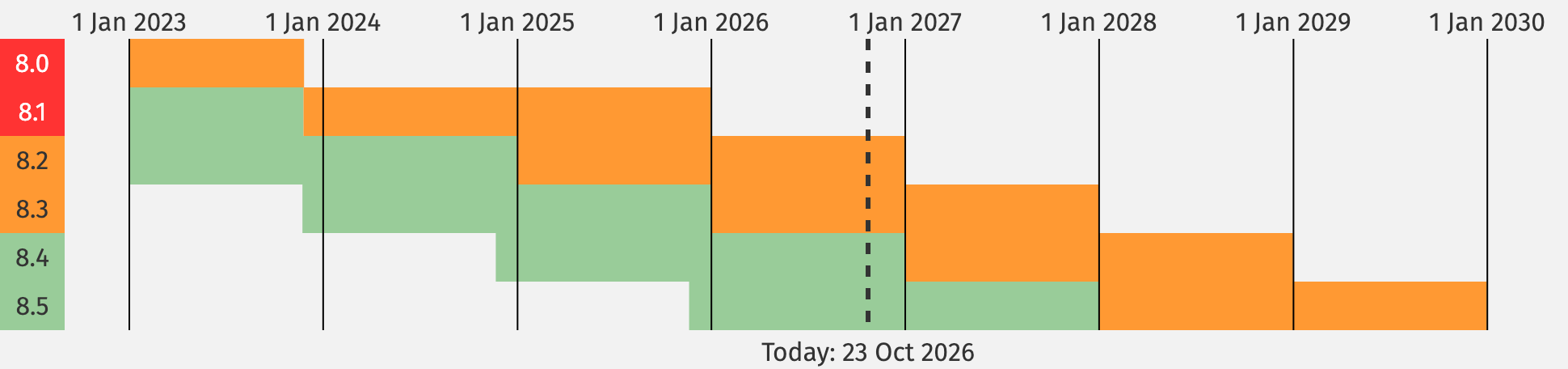
PHP 8.2, 8.3, 8.4 and 8.5 are still supported. PHP 8.4 and 8.5 get full support, while 8.2 and 8.3 only get security fixes.
Every PHP branch follows the same schedule. According to PHP’s supported versions page, each one is “fully supported for two years from its initial stable release,” then gets two more years of fixes “for critical security issues only.” After that it’s end of life, and PHP warns that anyone still on it “may be exposed to unpatched security vulnerabilities.”
Here’s every branch you’re likely to run into, with dates from PHP’s supported versions and end-of-life pages, checked October 23, 2026:
| PHP version | Latest release | Full support until | Security fixes until | PHP2Shell fix? |
|---|---|---|---|---|
| 8.6 | 8.6.0 RC4 (test build, Oct 21, 2026) | Not released yet | Not released yet | Yes, in RC4. Not for production use |
| 8.5 | 8.5.12 (Oct 21, 2026) | Dec 31, 2027 | Dec 31, 2029 | Yes, 8.5.12 |
| 8.4 | 8.4.27 (Oct 21, 2026) | Dec 31, 2026 | Dec 31, 2028 | Yes, 8.4.27 |
| 8.3 | 8.3.36 (Oct 21, 2026) | Ended Dec 31, 2025 | Dec 31, 2027 | Yes, 8.3.36 |
| 8.2 | 8.2.35 (Oct 21, 2026) | Ended Dec 31, 2024 | Dec 31, 2026 | Yes, 8.2.35 |
| 8.1 | 8.1.34 (Dec 18, 2025) | Ended | Ended Dec 31, 2025 | No official release |
| 8.0 | 8.0.30 (Aug 3, 2023) | Ended | Ended Nov 26, 2023 | No official release |
| 7.4 | 7.4.33 (Nov 3, 2022) | Ended | Ended Nov 28, 2022 | No official release |
The short version: if your site is on PHP 8.2 or newer and on the latest release of that branch, you’re in good shape for now. If it’s on 8.1 or older, it’s running software nobody is fixing anymore.
When is PHP 8.6 coming out?
PHP 8.6 is planned for November 19, 2026. It’s in release candidate testing now, and the last test build, RC5, is scheduled for November 5.
The dates come from the PHP 8.6 release schedule on the PHP wiki, which targets a general release “in late November” like every PHP version before it. The PHP team’s RC4 announcement is blunt about the test builds: “Please DO NOT use this version in production.”
When 8.6 does arrive, don’t rush your business website onto it. Brand new PHP versions are for developers to test against. Your plugins, theme and host need time to catch up, and a few weeks of other people finding the bugs first costs you nothing. When 8.6 ships, this page will be the first thing we update.
When did PHP 7.4 and PHP 8.1 reach end of life?
PHP 7.4 reached end of life on November 28, 2022. PHP 8.1 followed on December 31, 2025. Neither gets official security fixes anymore.
Here’s how the most common old versions line up, from PHP’s end-of-life list:
- PHP 8.1: end of life December 31, 2025. Last release 8.1.34.
- PHP 8.0: end of life November 26, 2023. Last release 8.0.30.
- PHP 7.4: end of life November 28, 2022. Last release 7.4.33.
PHP2Shell is a good example of what end of life actually means. When the October 2026 fixes shipped, PHP’s security advisory said plainly that “PHP 8.1 and older no longer receive updates from the PHP project.” Because the flaws were so serious, the PHP security team did publish minimal source fixes for 7.4, 8.0 and 8.1, but only “to help people building from source or without access to an LTS vendor.” That’s not something a typical small business website gets on its own. In practice, a site on PHP 8.1 or older is relying on its host to backport fixes, and plenty of hosts don’t.
PHP 8.2 is next. It loses security support on December 31, 2026, about two months from now. If your site is on 8.2, now is a good time to plan the move to 8.3 or 8.4 rather than doing it in a panic in January.
How many websites still run an outdated PHP version?
About half of PHP websites run a version that no longer gets security fixes, based on our math from W3Techs data. PHP 7 alone still powers 26.9% of PHP sites.
As of October 23, 2026, W3Techs reports this split among websites that use PHP:
- PHP 8: 65.3%
- PHP 7: 26.9%
- PHP 5: 7.7%
Within PHP 8, W3Techs’ breakdown shows 15.1% of those sites on PHP 8.1 and 5.8% on PHP 8.0, both already end of life. Add those to every PHP 7 and PHP 5 site and you get roughly 48% of PHP websites on a version the PHP project no longer patches. That’s our calculation from W3Techs’ public numbers, not a count of hacked or vulnerable servers, but it gives you a sense of how common this is. If your site is one of them, you have a lot of company, just not the kind you want.
Which PHP version should WordPress use?
WordPress recommends PHP 8.3 or newer. WordPress 7.0 and 7.1 support PHP 7.4 through 8.5, but PHP 7.4 and 8.1 no longer get security fixes.
The recommendation comes from WordPress’s requirements page, which says WordPress still works on PHP 7.4 in legacy setups but warns those versions are end of life. The WordPress PHP compatibility chart shows WordPress 6.9, 7.0 and 7.1 all support PHP 8.5, while WordPress 6.8 tops out at 8.4.
Our take for a typical business site: PHP 8.3 or 8.4 is the sweet spot right now. Both are patched, both have long security runways, and well-maintained plugins generally support them. PHP 8.5 is a fine choice once you’ve confirmed your plugins and theme are ready. PHP 8.2 works today but runs out of fixes at the end of the year.
WordPress itself also needs to be current for this to work. Our post on the WordPress 7.0 update covers what changed there.
How do I check what PHP version my website uses?
In WordPress, go to Tools, then Site Health, then Info, and open the Server section. Your hosting control panel shows it too.
A few ways to find it, from easiest to nerdiest:
- WordPress Site Health: Tools, then Site Health, then the Info tab, then Server. The PHP version is listed right there. Our guide on how to update PHP in WordPress has screenshots of exactly where to look.
- Your hosting panel: cPanel’s MultiPHP Manager, Plesk, or your host’s PHP settings page shows the version each site uses.
- Ask your host: “Which PHP version, including the last number, is my site running?” A good host answers in one message.
- From the command line: if you have SSH access,
php -vprints a version. Careful though: the command-line PHP and the PHP serving your website can be different versions on the same server, so trust Site Health or your host over this.
Can you check another website’s PHP version from the outside? Sometimes. Some servers send an X-Powered-By header that names the PHP version, which you can see in your browser’s developer tools under the Network tab. Most well-run servers hide it on purpose, so a missing header tells you nothing. For your own site, the methods above are the reliable ones.
How do I update to the latest PHP version?
Back up your site, update WordPress and your plugins, then change the PHP version in your hosting control panel and test the site. Most hosts let you switch back if something breaks.
The exact buttons are different at every host, so we wrote a separate, step-by-step guide covering GoDaddy, Bluehost, HostGator, SiteGround, Hostinger, DreamHost, WP Engine, Kinsta and Namecheap: How to Update PHP in WordPress (and When to Fire Your Host).
Two rules of thumb before you click anything:
- Patch releases aren’t optional. Going from 8.3.35 to 8.3.36 fixes security holes and shouldn’t change how your site behaves. Your host should do this for you. If they don’t, that’s a problem with the host.
- Big jumps deserve a test run. Going from 7.4 to 8.4 skips several versions’ worth of changes, and older plugins can trip over them. Try it on a staging copy first, or at least have a fresh backup and an hour to click around afterward.
Is PHP still worth using in 2026?
Yes. PHP still runs 69.3% of websites whose server-side language is known, including every WordPress site, and it gets new releases every year.
That number comes from W3Techs, and it’s the boring, useful kind of popularity: lots of hosts, lots of developers, lots of plugins, and a release schedule you can plan around. PHP 8 also brought real improvements to the language. PHP’s PHP 8.0 release page lists a JIT compiler, named arguments, union types, attributes and the match expression, and every version since has added more.
“PHP is dying” takes have been around for years, and PHP keeps shipping new releases anyway. For a business website, the risk that matters is running an old version of it.
What PHP version do Snazzy-hosted websites run?
Every website we host runs PHP 8.2.35, 8.3.36 or 8.4.27, all patched against PHP2Shell. We installed the fixed builds within four hours of PHP’s October 21 release.
We checked again on October 23, server by server, and none of the sites we host runs PHP 8.1 or older. Keeping PHP current is part of the job when we host and maintain a site, the same way we handle WordPress, plugin and security updates, so our clients never have to look up the latest PHP version themselves. (You’re welcome to, of course. It’s a riveting read.)
If your current host is still running an old PHP version, or can’t tell you which one, take a look at our managed WordPress hosting. We handle the move, and the next emergency patch becomes our problem instead of yours.
Latest PHP version FAQ
Is PHP 8.3 stable?
Yes. PHP 8.3 has been a stable release since November 23, 2023, and it gets security fixes until December 31, 2027. Make sure you’re on the latest release, 8.3.36, which includes the PHP2Shell fix.
Is PHP 7.4 outdated?
Yes. PHP 7.4 reached end of life on November 28, 2022, and its last official release was 7.4.33. It gets no security fixes from the PHP project, so a site on 7.4 should move to PHP 8.3 or newer.
What’s the difference between PHP 7 and PHP 8?
PHP 8.0 added a JIT compiler, named arguments, union types, attributes, the match expression and the nullsafe operator, and later 8.x versions added more. Every PHP 7 version is now end of life, so PHP 8 is the only family still getting fixes.
Is PHP 8.5 safe to use?
Yes, on 8.5.12 or later. PHP 8.5 gets full support until December 31, 2027, and WordPress 6.9 and newer support it. Check that your theme and plugins are ready before you switch.
How often does PHP release a new version?
PHP ships a new version branch once a year, usually in late November, and patch releases for supported branches throughout the year. Emergency security releases, like the one on October 21, 2026, come out whenever they’re needed.
Does PHP update automatically on my website?
No. Your web host controls which PHP version your site runs. Good managed hosts install patch releases for you, but switching to a newer version like 8.3 or 8.4 usually happens in your hosting control panel or through your host.