

Is Namecheap legit? Yes. Namecheap is a real, ICANN-accredited domain registrar that has been selling domains since 2000, and it looks after more than 24 million of them. The cheap price is real too, but it mostly applies to your first year. This guide covers who runs Namecheap, what a .com actually costs after year one, its security record, the August 2026 outage, and when we’d tell a business to use it and when we wouldn’t.
We set up domains, DNS and hosting for small businesses every week, so we spend a lot of time untangling where a company’s domain, website and email actually live. Every price and claim below links to Namecheap’s own pages, ICANN, or a named news source, checked on October 23, 2026.
Is Namecheap legit?
Yes. Namecheap is an ICANN-accredited domain registrar founded in 2000 and based in Phoenix, Arizona, and it manages more than 24 million domains.
The quickest way to check any registrar is ICANN’s own list. “NameCheap, Inc.” appears on ICANN’s list of accredited registrars, and the IANA registrar ID list shows it as accredited under ID 1068. Accreditation means Namecheap has a contract with ICANN and has to follow its rules on transfers, renewals and contact details.
Namecheap’s About page says it began in 2000 and lists “24m+” domains under management and more than 2,600 staff across 18 countries. Its legal address in the registration agreement is in Phoenix, and the agreement is governed by US and Arizona law.
Reviews depend on where you look. On Trustpilot, Namecheap has a 4.2 TrustScore from more than 22,000 reviews. The Better Business Bureau gives it a D- and says that’s because 153 complaints went unanswered. Namecheap isn’t BBB accredited. Both numbers can be true at once. The BBB grade comes from unanswered complaints, not from any finding that Namecheap is a scam, and it’s a small slice of a company with 24 million domains. Many of the complaints you’ll find online trace back to suspensions, which we cover below.
Who owns Namecheap?
Richard Kirkendall founded Namecheap, and Hillan Klein is its CEO. It’s a private company, and a private equity firm was reported in 2025 to be buying a majority stake.
Namecheap’s About page lists Kirkendall as founder and Klein as Chief Executive Officer. Klein, the longtime COO, took over as CEO in December 2025, according to Domain Investing. In September 2025, Domain Name Wire reported, citing the Wall Street Journal, that CVC Capital Partners agreed to buy a majority stake in a deal valuing Namecheap at about $1.5 billion including debt, with Kirkendall keeping a large stake. Neither company has published its own announcement that we could find, so treat the ownership details as reported rather than confirmed.
If you’ve seen Spaceship, the newer registrar, it’s related. Spaceship’s launch announcement from August 2023 says Namecheap “lifted the curtain on Spaceship,” and Spaceship’s trademarks belong to Namecheap, Inc. Spaceship has its own ICANN accreditation as a separate company (IANA ID 3862).
Why is Namecheap so cheap?
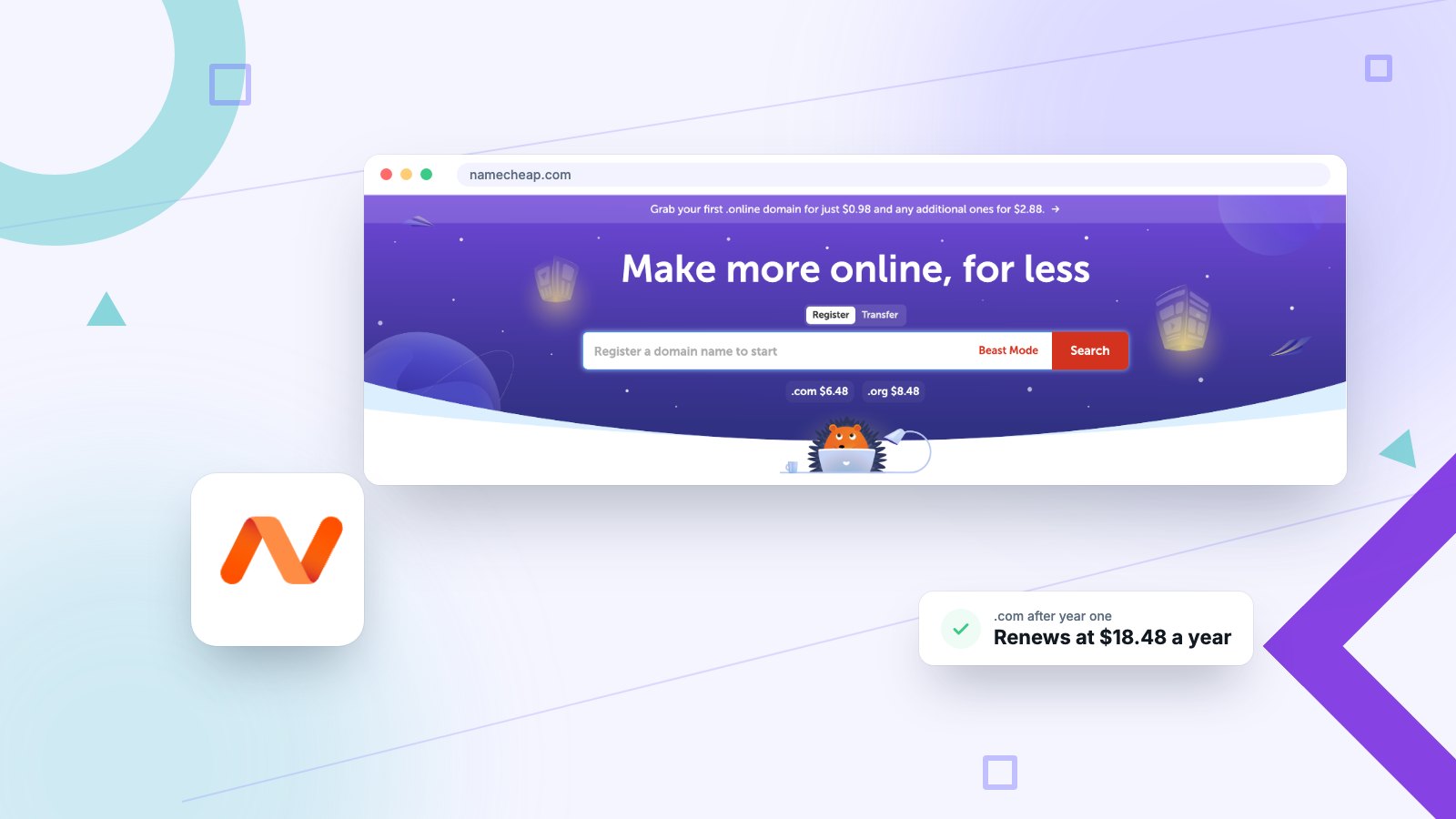
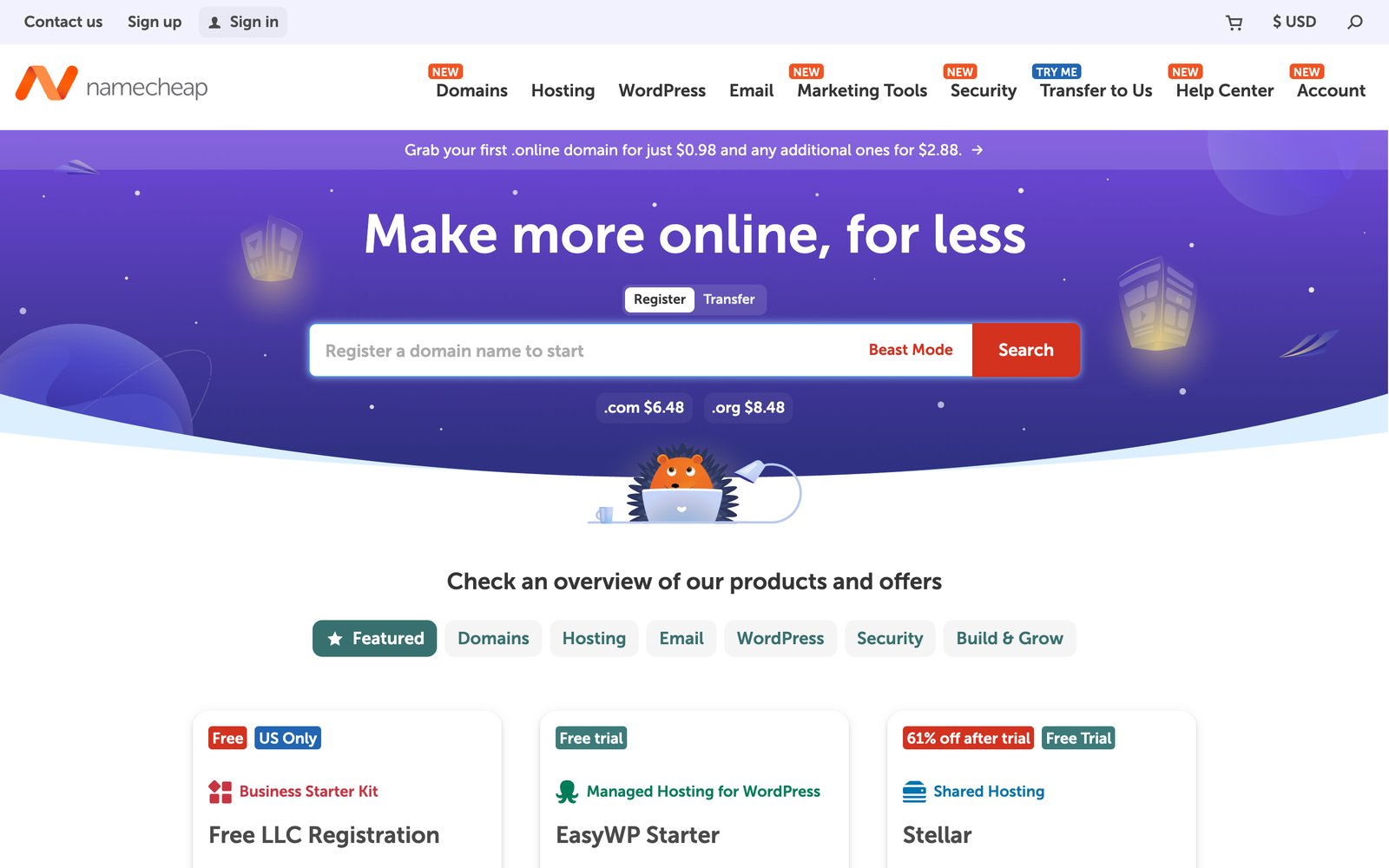
The low price is mostly the first year. A .com costs $11.28 for year one, or $6.48 for new customers, then renews at $18.48 a year.
Almost every registrar does this. The headline price gets you in the door, and the renewal price is what you actually pay for the next ten years. Here’s what Namecheap listed on October 23, 2026 (logged out, before any coupon codes):
| Domain | First year | Renewal (per year) | Transfer in |
|---|---|---|---|
| .com | $11.28 (sale, normally $14.98) | $18.48 | $11.48 |
| .net | $12.48 (sale, normally $14.98) | $18.58 | $12.98 |
| .org | $8.48 (sale, normally $14.48) | $18.98 | $12.28 |
Prices come from Namecheap’s .com, .net and .org pages. The $6.48 .com is a “new customer special” for first-year registrations, limited to one per person or household. ICANN also charges a $0.20 yearly fee, which Namecheap adds on top for some domains. And the registration agreement lets Namecheap change its prices at any time, with changes kicking in when you renew.
Namecheap’s .com page also warns that “registry prices for .com are rising” and offers multi-year renewals at a discount before November 1. The registry raises .com prices for every registrar, not just Namecheap, so expect the $18.48 renewal to move.
What keeps Namecheap’s total cost low is what’s included. Every new registration and transfer gets free lifetime WHOIS privacy through its “Withheld for Privacy” service, so your name, address and phone number don’t sit in the public domain records. Some country domains, including .us, .ca, .uk and .de, can’t use it because their registries don’t allow it. If you only care about the lowest possible renewal, Cloudflare sells domains at cost with no markup; we compared the two big names in Cloudflare vs GoDaddy domain pricing.
Is Namecheap safe?
Yes, for most people. We found no reported breach of Namecheap’s own systems that exposed customer data, and it offers free two-factor login and registrar lock.
Namecheap has had two security incidents worth knowing about, and neither was a break-in to its customer database:
- February 2023: phishing emails sent through Namecheap’s email provider. Fake DHL and MetaMask emails went out through the SendGrid account Namecheap used for renewal notices. BleepingComputer reported that Namecheap said its own systems were not breached and blamed the third-party sending service. Namecheap told customers to ignore the emails and said accounts and personal information remained secure.
- September 2014: password-stuffing attack. Attackers tried lists of usernames and passwords stolen from other websites against Namecheap logins. The Hacker News reported that Namecheap said “the vast majority” of attempts failed, and it blocked more than 30,000 IP addresses.
The 2014 attack is the more useful lesson. It only works on people who reuse passwords, which is why your domain account deserves the same protection as your bank. Three settings do most of the work:
- Turn on two-factor login. Namecheap’s free 2FA works with an authenticator app or a hardware key like a YubiKey. Its help docs list those two methods and no SMS option, which is the safer setup anyway.
- Leave registrar lock on. It blocks someone from transferring your domain away, and Namecheap says it’s on by default for every domain. Only turn it off when you’re moving a domain yourself.
- Distrust emails asking for your login. Namecheap says it will never ask for your account password or full card details by email. Fake renewal notices are a classic small-business scam, in the same family as the PayPal invoice scam.
What happened in the Namecheap outage in August 2026?
A storm knocked out cooling at the Phoenix data center Namecheap uses on August 13, 2026, taking its website, hosting, email and DNS settings offline.
In Namecheap’s own write-up, CEO Hillan Klein says the cause was a cooling failure at the RadiusDC Phoenix data center, which told Namecheap to take services offline so the hardware wouldn’t overheat. (Early posts on X named a different facility; Namecheap later corrected that.) Namecheap.com, shared, VPS and dedicated hosting, EasyWP, Private Email and its support chat were all affected.
Two details matter if you’re deciding whether to trust Namecheap with your business:
- DNS kept answering, but you couldn’t change anything. Namecheap says DNS zone resolution stayed available while DNS management was down. So a domain pointed at a website hosted somewhere else kept working, but nobody could log in to change a record until the dashboard came back.
- Email was delayed, not deleted. Private Email couldn’t send, and incoming mail couldn’t be delivered while the servers were off. Namecheap points out that sending servers retry, so messages arrived late rather than disappearing.
Namecheap called it a first in its 25-year history and promised more redundancy across its data centers in Europe and Asia. Namecheap didn’t publish a total duration; outside write-ups put the recovery into August 14. A smaller incident followed on August 26, when HostScore reported that 78 shared hosting servers were down for a little over two hours.
The same risk exists at any company that holds your domain, your DNS, your website and your email at once: one data center problem takes all four down together. Those are four separate jobs, and they don’t have to live in the same building.
Is Namecheap good for web hosting?
It’s fine for a hobby site or a simple brochure site. For a business website that brings in leads, we’d keep the domain at Namecheap and host somewhere else.
Namecheap’s shared hosting starts at $2.28 a month for the Stellar plan on a yearly term, with a 30-day free trial, and the page advertises a 100% uptime guarantee and data centers in the US, the Netherlands, the UK and Singapore. The fine print says the discount doesn’t apply to renewals, and the page doesn’t show what renewal costs, so check that in your cart before you pay. Its managed WordPress product, EasyWP, starts at $3.24 a month billed yearly and renews at $5.74 a month.
Those are honest prices for what you get. Budget shared hosting puts many sites on one server, and when something goes wrong you’re in a support queue with everyone else, as Namecheap’s customers were in August. That’s fine for a personal blog. It’s a bigger deal when your site is where customers book, buy or call you.
We sell website hosting and maintenance ourselves, so weigh our opinion with that in mind. For our own clients, we split the layers. The domain stays at a reputable registrar (Namecheap is fine), DNS runs through Cloudflare, the website runs on servers we manage, and email lives with a dedicated email provider. When one company has a bad day, the other three keep working. If you’re wondering whether Cloudflare is a safe place for your DNS, we covered that in is Cloudflare safe.
Namecheap vs GoDaddy: which is better?
For keeping a domain long term, Namecheap is cheaper. GoDaddy’s .com costs a penny up front but requires three years, and each extra year is $22.99.
On October 23, 2026, GoDaddy’s .com page listed the first year at $0.01 with a “3-year purchase required” and “Additional year(s) $22.99,” plus ICANN fees, and said renewal pricing is subject to change. That makes three years at GoDaddy about $45.99, against $41.24 for three years at Namecheap’s sale price, before taxes and fees. After that, Namecheap’s .com renews at $18.48 a year against GoDaddy’s $22.99 list price.
Both include free domain privacy now. GoDaddy turns it on automatically for eligible domains through Domains By Proxy. If price is the only thing you care about, look at Cloudflare first; we break that down in Cloudflare vs GoDaddy.
Do you actually own a domain you buy from Namecheap?
Not exactly. You register a domain for a set number of years, more like a lease, and you keep it for as long as you renew on time.
The same goes for every registrar. ICANN’s own FAQ says “you do not ‘own’ a domain name” and compares it to leasing from the registry. Registrations usually run one to ten years, and you need to renew before it expires. Namecheap’s registration agreement says the same thing in legal terms: registration is a service and doesn’t create a property interest.
In practice, you control the domain as long as you do two things: keep auto-renew on with a card that won’t expire, and keep the account’s contact email current so the renewal and verification emails reach someone. The classic mess is a domain registered by someone who has since left the company, with nobody else holding the login.
Why do Namecheap domains get suspended?
Most suspensions come from abuse reports, contact details that were never verified, or payment problems. Verify your contact email and answer Namecheap’s messages quickly.
Suspensions are behind a lot of the angry reviews you’ll find. Namecheap’s own list of suspension reasons includes phishing, malware and spam reports, inaccurate WHOIS details, failing to verify your contact information (an ICANN requirement), court orders, payment verification and chargebacks. The registration agreement also lets Namecheap suspend everything in an account if it has grounds to suspend one service, which is worth knowing if you keep a dozen client domains in one login.
A legitimate business rarely trips these, but it happens. A hacked website can start serving malware and draw an abuse report against the domain, and a skipped verification email after registration can turn into a suspended domain. Keeping your website patched and your contact details up to date heads off both.
Should your business use Namecheap?
For registering and holding domains, yes. It’s legitimate, cheaper than GoDaddy to renew, and includes free privacy. Just don’t put everything with one company.
We tell clients that Namecheap is a good place to buy and keep domains. Turn on two-factor login, leave registrar lock on, set auto-renew, and keep the contact email pointed at an inbox someone checks. Then think twice before also putting your website and email on the same account. If Namecheap, your host or anyone else goes down, you want the damage to stop at one layer.
Frequently asked questions
Can you trust Namecheap?
Yes. Namecheap is an ICANN-accredited registrar that has been in business since 2000 and manages more than 24 million domains. Protect your account with two-factor login and keep registrar lock on.
Is Namecheap safe to buy a domain from?
Yes. Every new registration includes free lifetime WHOIS privacy, registrar lock is on by default, and no breach of Namecheap’s own customer systems has been reported. Watch the renewal price, which is higher than the first year.
Is Spaceship owned by Namecheap?
Spaceship was launched by Namecheap in 2023, and its trademarks belong to Namecheap, Inc. It operates as a separately accredited registrar under the name Spaceship, Inc.
Is Private Email from Namecheap?
Yes. Private Email is Namecheap’s own email hosting. After a free first month, the one-mailbox Launch plan renews at $14.88 a year. During the August 2026 outage it couldn’t send or receive mail for a while.
Does Namecheap charge for WHOIS privacy?
No. Namecheap includes its Withheld for Privacy service free for life with every new registration and transfer. A few country domains, such as .us, .ca, .uk and .de, can’t use it because of registry rules.
How do I know if Namecheap is down?
Check Namecheap’s status updates page before you change any settings. During an outage, avoid moving nameservers mid-incident; the change takes time to spread and can leave you offline longer.
The short version
Namecheap is legit. It’s an ICANN-accredited registrar that’s been around since 2000, it includes free WHOIS privacy, and its .com renews for less than GoDaddy’s. Its security record has no reported customer-data breach, and its biggest stumble was the August 2026 data center outage. The cheap price is a first-year price, so budget for the renewal. And keep your domain, DNS, website and email from all depending on one company.
Not sure where your domain, DNS and email live, or who has the login? Talk to us and we’ll map it out and set it up so one bad day can’t take everything down.