
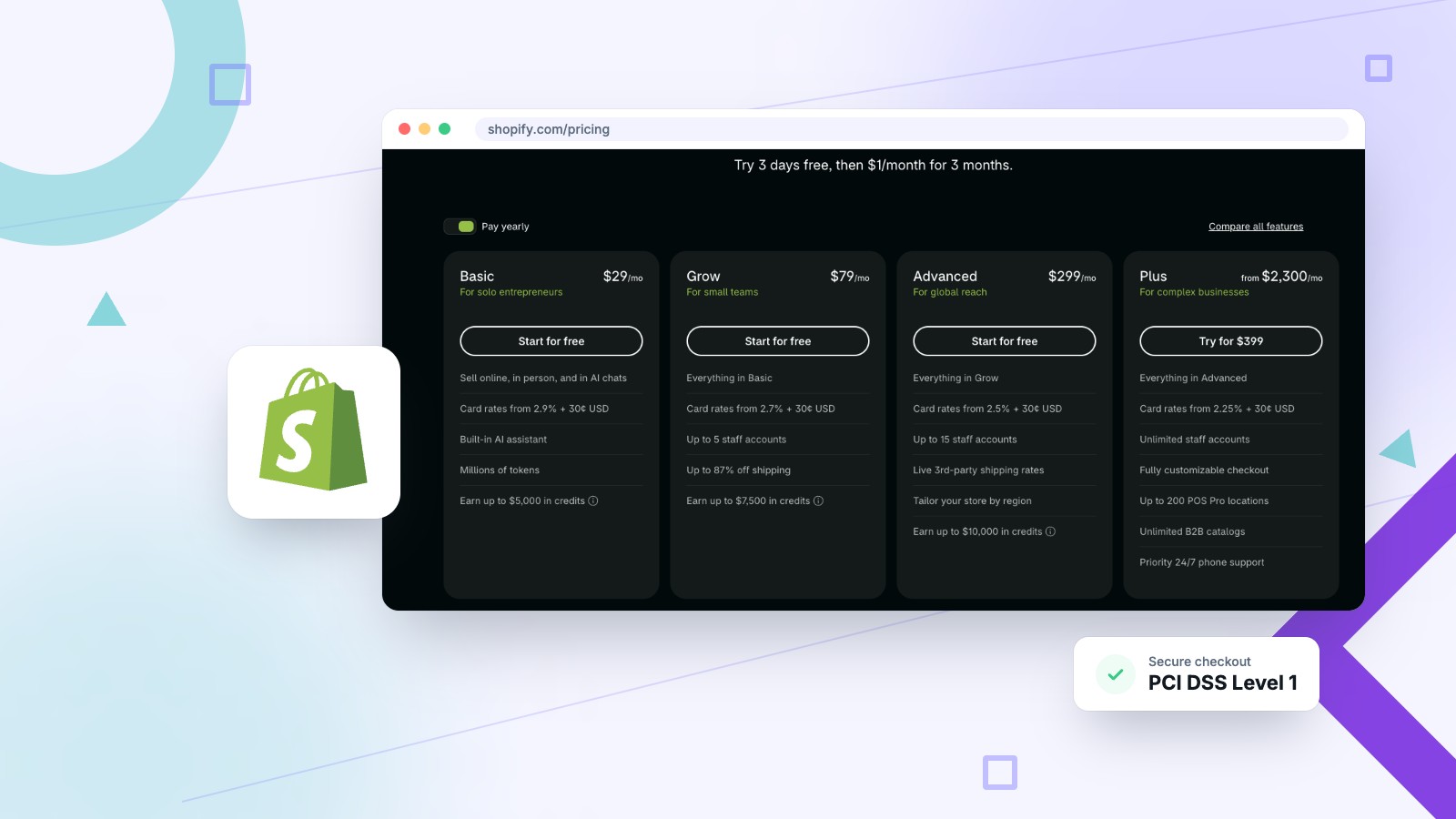

Is Shopify legit? Yes. Shopify is a publicly traded company that has run online stores since 2006, and about 10% of all U.S. ecommerce sales go through it. But “is Shopify legit” is really two questions. The platform itself is safe and heavily audited. The stores built on it are run by independent sellers, and some of those sellers aren’t honest. Below we cover why Shopify itself can be trusted, how to spot a scam store before you buy, what to do if you already got burned, and whether Shopify is worth it if you want to sell.
We build and manage Shopify stores for small businesses as a Shopify Partner, so this comes from people who work inside the platform every week. Every price and policy below links to Shopify’s own pages or a named source, checked in October 2026.
Is Shopify legit?
Yes. Shopify is a real, publicly traded ecommerce company founded in 2006. Millions of businesses use it, and its checkout meets the highest card-security standard.
Shopify started in Ottawa, Canada, and has been listed on the Toronto Stock Exchange and in the U.S. under the ticker SHOP since its 2015 IPO, according to its public company record. As a public company it reports its results every quarter, which is about as far from a fly-by-night operation as you can get.
The scale is hard to fake, too. Per Shopify’s own figures, businesses on Shopify have made more than $1 trillion in sales, more than 675 million unique shoppers bought from Shopify stores in 2023, and about 10% of U.S. ecommerce sales are processed through it. Its App Store lists more than 13,000 apps from outside developers.
So no, Shopify isn’t a scam. Whether a particular store on Shopify is legit is a separate question, and the rest of this guide is about answering it.
Is Shopify safe to buy from?
Shopify’s checkout and payments are secure, but Shopify is not the seller. Each store is an independent business, so the store’s honesty decides whether your order arrives.
When you buy from a store that runs on Shopify, you’re buying from that business. Shopify provides the software. Shopify’s own Shop help center spells out the split: the store is responsible for fulfilling your order, product support, returns and refunds, while Shop and Shopify handle the security of checkout and payments, store eligibility, and the tools you use to report problems.
Your card details are well protected either way. Shopify is certified PCI DSS Level 1, the top tier of the card industry’s security standard, and that certification covers every store’s checkout, shopping cart and hosting. A Shopify store leaking your card number is very unlikely. A dishonest seller taking your money and shipping a cheap knockoff, or nothing at all, is the realistic risk.
Shopify’s Acceptable Use Policy says it won’t tolerate anyone defrauding Shopify, other merchants or buyers. Still, anyone can open a store in minutes, so scam stores do show up, often around big shopping seasons and trending products. Your best protection is spotting them before you pay.
How can you tell if a Shopify store is legit?
Check outside reviews, the store’s policies, its contact details and how old its domain is. Be wary of prices far below normal and any request to pay outside checkout.
Shopify’s safe shopping advice starts with reviews, policies and suspiciously low prices. Here is the full checklist we use when a client asks us whether a store looks real:
- Search the store name plus “reviews” or “scam.” Reviews on the store’s own site can be faked. Look at Google, Trustpilot and Reddit instead. No footprint at all is a warning sign for a store selling popular products.
- Read the shipping, return and refund policies. A legit store explains where it ships from, how long delivery takes and how returns work. Vague or copy-pasted policies that name a different store are a red flag.
- Look for real contact details. A business address, a phone number and an email on the store’s own domain are good signs. A single Gmail address and a contact form are not.
- Check how old the domain is. A free ICANN domain lookup shows the registration date. A store registered three weeks ago selling name-brand goods at 70% off deserves a hard pass.
- Be suspicious of prices that seem too good. Shopify’s own advice is to be cautious when a price is far lower than you expect. Steep discounts on items that are usually expensive or sold out are the classic scam store hook.
- Pay through the checkout with a credit card, Shop Pay or PayPal. Never pay by wire, Zelle, crypto or gift card, and never pay through a link sent in a DM. Paying through the real checkout keeps your dispute rights intact.
If a store fails two or three of these, skip it and buy the same product somewhere with a track record.
What should you do if you got scammed by a Shopify store?
Contact the store first, then report the order in the Shop app, dispute the charge with your bank or card issuer, and report the store to Shopify.
- Message the store. Keep it in writing so you have a record. Sometimes a late order is just late.
- Report the order in Shop. If you bought through the Shop app and the store has not responded within 30 days of your purchase, Shop lets you report an issue with that order.
- Dispute the charge. Shop’s guidance for unresponsive stores or suspected fraud is to contact your bank or the payment provider you paid with. For credit cards, the FTC says your dispute letter should reach the card issuer within 60 days after the first bill with the error was sent to you, and the Fair Credit Billing Act covers goods that were not delivered as agreed.
- Report the store to Shopify. Use Shopify’s report a merchant page and include the store link, your proof of purchase and what happened. It helps get the store shut down before it catches the next person.
Will Shopify refund you directly? Usually not. The store is the seller, so your money comes back through the store or through your bank’s dispute process, which is why paying with a credit card matters so much.
Is Shop Pay safe?
Yes. Shop Pay encrypts your saved cards, meets payment industry security standards and only shares your shipping and billing details with a store after you place an order.
Shop Pay is Shopify’s saved checkout. It stores your email, up to 20 shipping addresses, up to 10 cards with their billing addresses and your phone number, so you can check out in one tap on any store that offers it. According to Shop’s help center, saved cards are encrypted by Shop Pay, the saved information meets payment industry security standards, and your details reach a store only after you buy.
Shop Pay protects your card data. It can’t tell you whether a store will ship what it promised, so run the checklist above before you tap the button, the same as you would at any checkout.
Is Shopify safe for sellers?
Yes. Shopify handles card security, hosting and fraud screening for you. The biggest risks for sellers are phishing emails, fake “experts” and fraudulent orders.
On the platform side you get a lot out of the box. Because Shopify is PCI DSS Level 1 certified, you do not have to manage card-security compliance for your store yourself. Shopify’s fraud analysis flags risky orders using checks like address verification and CVV matches, and with Shopify Payments or the Grow plan and above it rates each order as low, medium or high risk of a chargeback. U.S. sellers using Shop Pay also get Shopify Protect, which reimburses the chargeback amount and fee when an eligible order turns out to be fraud.
Sellers usually get hurt by people working around the platform. These are the ones we see most:
- Phishing emails that look like Shopify. Shopify says it only sends email from domains like @shopify.com, @email.shopify.com and @em.shopify.com, and never asks for passwords, card numbers or banking details in an email. “Your store will be suspended, verify now” messages from a Gmail address are fake. Forward them to phishing@shopify.com.
- Fake “Shopify experts” in your inbox or DMs. Messages offering to fix your store, boost your sales or recover your traffic, then asking for staff access or payment up front. Real partners don’t cold-message you with urgent warnings about your store.
- Fraudulent orders. Stolen cards used on your store lead to chargebacks weeks later. Review medium and high risk orders before you ship, and don’t rush an unusually large order out the door just because it looks like a big win.
What does Shopify cost, and what are the downsides?
Shopify plans run from $39 a month (or $29 a month billed yearly) up to $2,300 a month, plus card fees. The downsides are fees, app costs and less control than self-hosted options.
Here is the current U.S. pricing from Shopify’s pricing page, checked October 2026:
| Plan | Billed monthly | Billed yearly | Online card rate (Shopify Payments) | Fee if you use another payment provider |
|---|---|---|---|---|
| Basic | $39/mo | $29/mo | 2.9% + 30¢ | 2% |
| Grow | $105/mo | $79/mo | 2.7% + 30¢ | 1% |
| Advanced | $399/mo | $299/mo | 2.5% + 30¢ | 0.6% |
| Plus | From $2,300/mo | n/a | 2.25% + 30¢ | 0.2% |
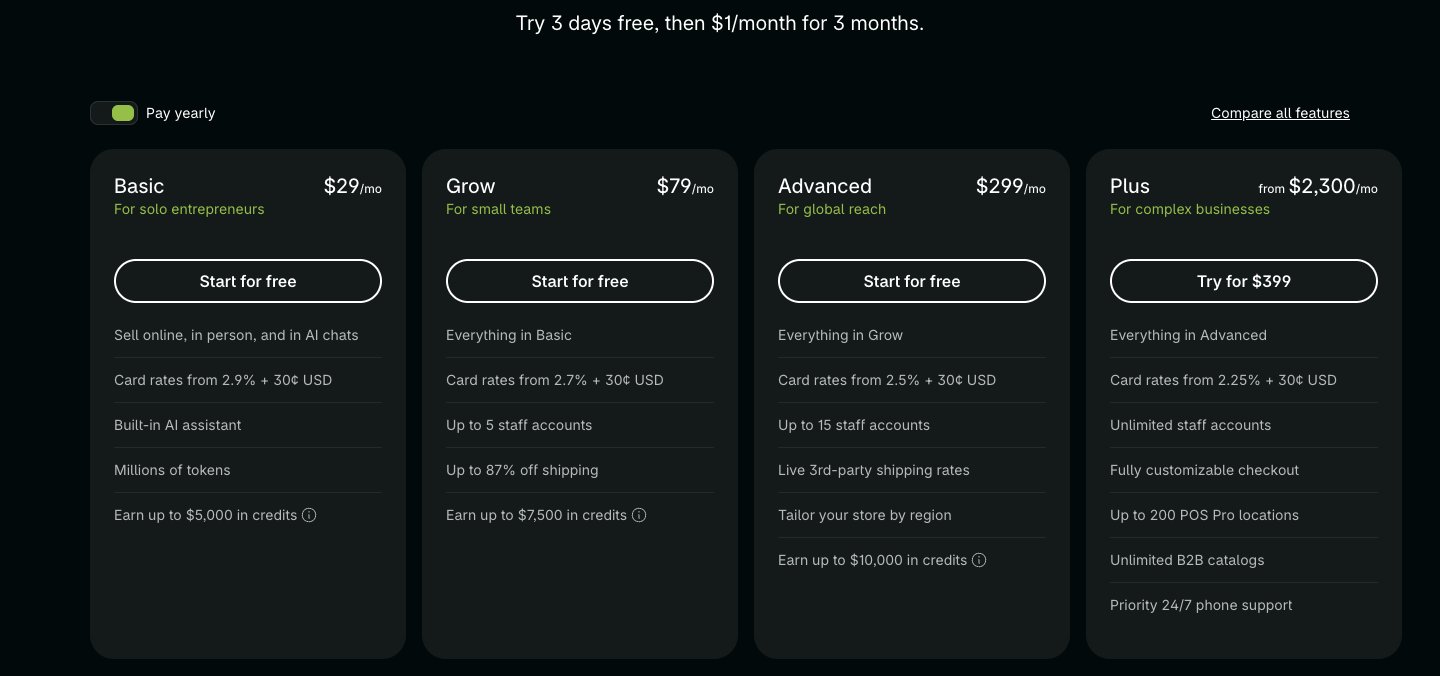
Shopify’s trial is 3 days free, then $1 a month for 3 months, before the regular price kicks in. Premium cards cost a bit more to process than the standard rates above, and the pricing page lists those too.
The downsides we run into when building these stores for clients:
- Fees stack up. The plan, the card processing and the extra fee for outside payment providers all come out of each sale. Use Shopify Payments if you can, since that removes the third-party fee.
- Apps are where the budget goes. Reviews, subscriptions, upsells and bundles often come from paid apps with their own monthly fees. A store with ten apps can cost far more than its plan.
- You rent the platform. You can export your products and customers, but you cannot move your Shopify theme to another host, and deep checkout changes are limited on most plans. A WordPress store gives you more control in exchange for more upkeep.
- You still need traffic. Shopify gives you the store, and finding shoppers is on you. Nobody finds a new store by default the way they browse a marketplace, so plan for SEO, ads or social from day one.
For a full picture of what a store costs beyond the platform, our guide to how much a website costs covers design, ecommerce and yearly running costs.
Is Shopify worth it for a small business?
Shopify is worth it if you sell physical products online and want secure checkout, payments and hosting handled for you. It is overkill for a simple brochure website.
Shopify shines for product businesses: inventory, shipping labels, taxes, abandoned cart emails and a checkout millions of shoppers already trust. We explain why in more detail in why Shopify is ideal for product companies.
It is a weaker fit if you mainly need a site that explains your services and collects leads, like a contractor, a law firm or a clinic. A WordPress or Squarespace site usually does that job for less money each month. Our comparison of WordPress vs Squarespace walks through that choice.
Want to test Shopify before paying? As a Shopify Partner we can set you up with an unlimited Shopify trial. You can build your whole store with no time limit, and you only start paying when you are ready to make sales.
Shopify FAQ
Will Shopify refund me if I get scammed?
Usually not directly. The store you bought from is the seller and is responsible for refunds. If the store will not help, dispute the charge with your bank or card issuer and report the store to Shopify.
Can I trust Shopify with my credit card?
Yes. Shopify is certified PCI DSS Level 1, the highest card-security level, and Shop Pay encrypts saved cards. The bigger risk is a dishonest seller, not your card data leaking from the checkout.
How do I know if I got scammed on Shopify?
Common signs are an order that never ships, tracking that never updates, a product that is clearly a knockoff, and a store that stops answering. If that happens, document everything and start a dispute with your card issuer.
Why is Shopify charging me $39 or $40 a month?
If you have a Shopify store, that is most likely the Basic plan at $39 a month billed monthly, plus any sales tax. Switching to yearly billing drops it to $29 a month. If you never opened a store, contact your bank.
Which is better, Amazon or Shopify?
Amazon brings shoppers to you but owns the customer relationship and sets the rules. Shopify gives you your own store, brand and customer list, but you bring the traffic. Many businesses use both.
Is there any risk with selling on Shopify?
The platform is secure, so the main risks are business ones: fees and app costs eating margin, fraudulent orders, and phishing emails that try to steal your login. Turn on two-step login and review risky orders before shipping.
The short version
Shopify is legit: a public company, PCI DSS Level 1 certified, behind about a tenth of U.S. online sales. Individual Shopify stores are only as honest as the people running them, so check reviews, policies, contact details and domain age before you buy, and pay with a credit card so you can dispute a bad order. If you sell, Shopify handles the hard security work for you. Your job is watching fees, apps, fake “Shopify” emails and risky orders.
Thinking about opening a Shopify store, or not sure Shopify is the right fit for your business? Tell us what you sell and we will give you a straight answer, even if it is “you do not need Shopify.”