

If you want to sell peptides online, the hard part is everything around the product. Shopify won’t support the checkout you need, Stripe and Square close peptide accounts, and most big hosting companies will pull your site after a single complaint. We build and host online stores for peptide sellers, and in 2026 alone our clients have lost payment processors, had a domain suspended by GoDaddy (we had that store back online in 45 minutes), and been given 24 hours to get off a server. This guide covers what we’ve learned about the website, the hosting and the payments, so your peptide business stays online.
One note before we start: we build websites, we’re not lawyers. Where the law comes up, we link to the FDA and to attorneys who work in this space, and you should talk to one before you launch.
Can you sell peptides on Shopify?
In practice, no. Shopify’s checkout can’t enforce the research-use and age confirmations processors require, so peptide stores end up on self-hosted WooCommerce instead.
Shopify’s own product rules for its Shop channel list “drugs and drug-related products” and “medication” as ineligible. Shopify Payments runs on Stripe, which brings its own restrictions (more on that below). And even if you bring an outside processor, you run into a practical wall.
High-risk processors and their banks usually require every buyer to tick a box confirming the product is for research use and that they’re of age. On Shopify, shoppers can skip that step through Buy Now buttons and the Shop app. One client came to us for exactly that reason: their processor required the checkbox, Shopify couldn’t guarantee it, so we moved them to WooCommerce.
That move took about a week. We carried over 15 affiliates with their links and history and 11 wholesale accounts, and the owners stopped paying roughly $230 a month in Shopify apps. WooCommerce on your own server gives you full control of the checkout, the compliance fields and which payment gateways you install, and nobody can switch your store off from a platform dashboard.
Why do Stripe and Square shut down peptide stores?
Mainstream processors treat peptides as high risk. Their policies restrict pharmaceuticals and research chemicals, and they can close an account and hold the funds.
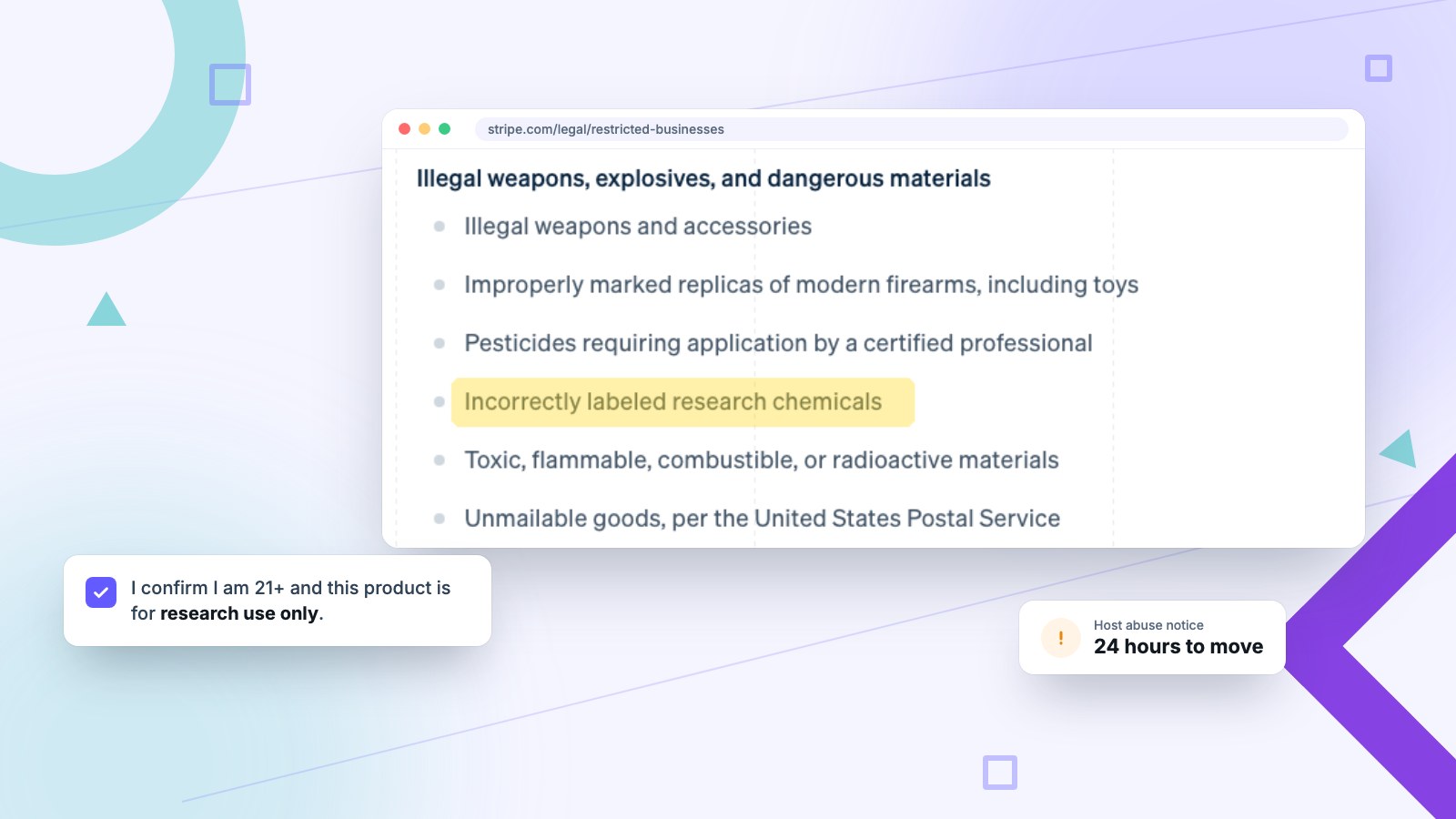
Stripe’s restricted and prohibited businesses list prohibits “incorrectly labeled research chemicals” and “pseudo-pharmaceuticals or nutraceuticals that are not safe or make harmful claims,” and restricts pharmaceuticals and prescription-only products. Peptide stores sit right on top of those lines, and the processor decides which side you’re on, often after it has already taken your payments.
Here’s what that looked like for our clients this year:
- A payment provider closed one client’s account and held about $40,000 of their money.
- Every peptide client we work with changed payment processors at least twice in 2026.
- One client spent two months getting through a high-risk processor’s review (a paid compliance review, website changes, bank statements) and was declined by the bank at the end. A mainstream account they knew could close at any time was the only thing keeping orders flowing.
Never run a peptide store on a single payment processor.
What is the best peptide payment processor?
A high-risk processor that knows the category and approves you openly, plus a second one ready as backup. Expect higher fees, a reserve and slower payouts.
There are two kinds of options out there. Some providers will process for you by quietly ignoring their own terms, which works until it doesn’t and usually ends in a closed account and frozen funds. Real high-risk processors underwrite you knowing what you sell. They cost more, and they’re the only kind worth building a business on.
To give you a real number, here’s one offer a client received from a high-risk processor in 2026:
| Term | What the processor offered |
|---|---|
| Onboarding fee | $800, one time |
| Processing fee | 10% of each transaction |
| Rolling reserve | 10% of sales held for 180 days |
| Payout timing | Funds paid out 7 days after each sale |
Compare that with the 2.9% most online stores pay. Price it into your margins from day one. And plan for a slow approval: applications usually ask for your operating agreement, several months of bank and processing statements and a voided check, and one client’s launch waited about six weeks on a processor.
The fallback options cost you sales. Zelle and messaging-app checkouts are manual, and when one store tried a crypto-based card checkout as a backup, only about one in five attempted payments went through. They’re better than nothing on a bad week, but they’re not a plan.
What do payment processors check on a peptide website?
Processors review your website before approving you. Expect them to check your contact details, age policy, research-use language, product claims, lab reports and policy pages.
This is where a lot of applications fail, and it’s the part we spend the most time on. Across our clients, processors and their banks asked for:
- Real contact information, including a physical business address
- A 21+ age policy, with an age confirmation at checkout
- A clear “research use only, not for human consumption” disclaimer on product pages and in the footer
- A required, unticked research-use checkbox at checkout
- No medical, wellness or anti-aging wording anywhere, including product names
- Lab reports (certificates of analysis) visible for each product
- Complete refund, shipping and terms pages, plus a statement of where you ship
Some banks go much further. One required a store to put prices behind registration, verify every customer’s email, and remove product reviews, a calculator and a sign-up discount before it would approve processing. Each of those changes costs you something. A store that hides its catalog behind a login is invisible to Google, so traffic has to come from email, affiliates and ads instead of search. Our gated clients still do more than $10,000 a month, but it’s a different marketing plan, so decide which level of gating you need before you design the site. Our founder covers how we design product pages and checkouts to get through that review in his field notes on peptide website design.
Which web hosts allow peptide websites?
Most big hosts reserve the right to remove a store after one complaint. Few say so about peptides directly, and the hosts that tolerate this niche change often.
Peptide stores get complaints. At least one major drugmaker uses a brand-protection firm to file abuse reports against sites selling compounds similar to its products, and those reports go straight to your host, your CDN and your domain registrar. Here’s how the big hosting companies word their acceptable use policies:
| Host | What its policy says |
|---|---|
| Vultr | May terminate or suspend your account if you “create liability for us or any other person, including reputational harm” (AUP) |
| Hetzner | Has “the right to suspend access to all of our products” if its terms are broken (system policies) |
| DigitalOcean | Bans “unlawfully selling or distributing controlled substances, including but not limited to any illegal or prescription drugs” (AUP) |
| Google Cloud | Bans any “unlawful” use, including “violating intellectual property rights of others” (AUP) |
| Amazon Web Services | Bans use “for any illegal or fraudulent activity” (AUP) |
| Namecheap hosting | Bans the “sale of any controlled substances without providing proof of appropriate permit(s)” (AUP) |
None of these name peptides, but they give the host broad discretion, and when a legal complaint arrives from a drugmaker’s law firm, the easiest move for a host is to tell you to leave. In August and September 2026, two different cloud hosts gave peptide stores we manage 24 hours to move after a single complaint. A CDN also put a site-wide “Suspected Phishing” warning on one store over a report that had nothing to do with phishing.
Both stores stayed online, because we’d planned for it: we moved one to new servers the same night and had the other moved before the deadline, and the backup schedule meant no orders were lost. So the list of hosts that allow peptide sites matters less than you’d think, because it changes every few months as policies tighten and abuse teams change. What protects you is someone watching those policies and a store that can move in hours, not days.
How do you keep a peptide store online when a host or registrar acts?
Build the store so it can move. Keep off-server backups, a second host ready, a spare domain and DNS you control, then a takedown means hours offline, not weeks.
Domains are as exposed as hosting. When GoDaddy suspended one peptide seller’s domain, with a notice citing its rules against selling prescription medication without a prescription, the owner called us. Within 45 minutes of that call, his store was back online on a new domain, restored from a full backup of the website. That’s how we won him over as a client. If your store sits on a registrar or host that could do the same thing tomorrow, let us set you up right before it happens. Here’s the setup we use for every peptide store we host:
- A dedicated, portable server, not cheap shared hosting, set up so we can rebuild it on another provider quickly. In an emergency we can move a site in about ten minutes.
- Off-server backups on a frequent schedule, stored somewhere the host can’t delete them.
- A second host ready to go, so moving is a matter of restoring, not shopping for a provider at midnight.
- Cloudflare in front of the site for DNS, SSL and protection. If you’re wondering how much to trust it, we wrote about whether Cloudflare is safe.
- Your domain away from registrars that suspend on a complaint alone, plus a spare domain already pointed and ready. Our Cloudflare vs GoDaddy comparison covers why we move client domains, and the Namecheap outage in August showed what happens when a registrar has a bad day.
- US hosting where possible. Offshore hosting is slower for American shoppers and should be a last resort, not the default.
Your email, ad accounts and social profiles are single points of failure too. Use a business email on your own domain, and don’t let one personal Facebook profile be the only admin on your ad account.
Is it legal to sell peptides online?
It depends on the peptide and how you market it. A “research use only” label doesn’t protect a store whose website implies human use. Talk to a lawyer first.
The FDA has been clear on the labeling point. In a December 2024 warning letter to a peptide seller, the agency said that despite the store’s “RESEARCH USE ONLY” labels, evidence from its websites showed the products were intended as drugs for human use, which made them unapproved new drugs. The website was the evidence. That’s why the compliance details in the processor section above aren’t just for your bank, and why we keep medical claims, dosing language and before-and-after content off every peptide site we build.
Rules also differ by product and by state, and some owners move toward regulated telehealth with licensed pharmacies instead of research sales. For the legal side of starting a peptide business, from company structure to supply chain, this guide from a law firm that works with peptide founders is a good starting point. Then get your own counsel.
How do you start a peptide business online?
Set up the company and legal review first, apply for payments early, then build a compliant WooCommerce store on hosting that can move, with a backup processor ready.
The order matters, because the slow steps are the ones people leave for last. Here’s the sequence we’d follow if we were starting a peptide business online today:
- Form the company and talk to a lawyer about what you’ll sell, how you’ll describe it and where you’ll ship.
- Line up a supplier and independent lab testing, so every product has a certificate of analysis before it goes on the site.
- Apply to a high-risk processor right away. Approval can take weeks and needs months of bank statements, so start it before the website is finished.
- Build the store on WooCommerce with the compliance pieces processors look for: contact details, age and research-use confirmations, disclaimers, lab reports and full policy pages.
- Put it on hosting built to move, with off-server backups, a second host, Cloudflare in front and a spare domain.
- Launch with a backup payment option already installed and tested.
- Plan your traffic. If your processor requires a login wall, search engines can’t see your catalog, so lean on email, affiliates and wholesale accounts, and treat paid social ads as a channel that can disappear.
How much does it cost to run a peptide store online?
Plan for higher processing fees, reserves on your sales, compliance work on the site, and hosting built to move. Ours starts at $50 a month.
Processing is the big line: around 10% per transaction plus a reserve, using the offer above as a guide. Then there’s the store itself (WooCommerce is free, the work is in setting it up correctly), lab testing for your certificates of analysis, and hosting.
Our peptide hosting plan is $50 a month. Hosts change their policies all the time, so we keep track of which providers will and won’t support peptide stores, keep your site on infrastructure that can move, run the off-server backups, and help you stay ahead of a provider before it acts. If you also want us to keep WordPress, WooCommerce and your plugins updated and check your checkout and compliance pages every month, our maintenance plan is $100 a month.
Frequently asked questions
Can I use WooCommerce to sell peptides?
Yes. WooCommerce runs on your own WordPress site, so you control the checkout, the compliance checkboxes and which payment gateways you install. That’s why nearly every peptide store we work with uses it.
Will my web host shut down my peptide website?
Many will if they get a complaint. Most big hosts’ policies give them broad discretion to suspend sites that create legal risk. Two cloud hosts gave stores we manage 24 hours to move in 2026, so plan for it.
Do I need an age gate on a peptide website?
Most processors we’ve worked with required a 21+ age policy and an age confirmation at checkout. Some banks also required a login or registration wall before showing prices.
Why do peptide processors hold a reserve?
A reserve covers the processor if customers dispute charges after an account closes. One offer we saw held 10% of sales for 180 days. Budget for that cash being unavailable.
Should I host my peptide website offshore?
Usually not first. Offshore hosting is slower for US shoppers. A portable US setup with off-server backups and a second host ready is faster day to day and recovers quickly if a host acts.
What should a peptide product page avoid?
Avoid medical claims, dosing instructions, wellness or anti-aging language, and anything implying human use. Show the research-use disclaimer, the certificate of analysis, and purity and storage details instead.
The short version
To sell peptides online and stay online, skip Shopify and build on WooCommerce, line up a real high-risk processor plus a backup, and build the website to pass a processor’s review: real contact details, age and research-use confirmations, lab reports and no human-use claims. Then host it somewhere you can leave in an afternoon, with backups, a second host and a spare domain ready, because sooner or later a host, a CDN or a registrar will act on a complaint.
We build, host and maintain peptide stores, and our hosting plan is $50 a month. We won over a client whose domain GoDaddy shut off by getting him back online in 45 minutes, and we can do the same for you before you need it. Let us set you up right: tell us about your store, or call us at (919) 444-2005, and we’ll tell you where your setup is exposed.