

Is it legal to sell peptides? It depends on who you sell to and what your website says about the product. In the US, a peptide sold for people to use, without FDA approval, is an unapproved new drug, and a “research use only” label doesn’t change that if the rest of your site says otherwise. We build and host online stores for peptide sellers, so we watch this closely. In 2026 the FDA sent a wave of warning letters to online peptide sellers, and on October 28 HHS changed the rules for six peptides. This guide explains where the lines are now, using the FDA’s own letters.
One note before we start: we build websites, we’re not lawyers, and this isn’t legal advice. We link to the FDA and to the law firms covering this. Talk to a regulatory attorney about your own products before you launch or change anything.
Is it legal to sell peptides in the US?
Only in narrow cases. FDA-approved peptide drugs are legal by prescription. Unapproved peptides sold for human use are illegal, whatever the label says.
Most peptides aren’t controlled substances, so the question is whether a product is an approved drug. Under the Federal Food, Drug, and Cosmetic Act, a product becomes a “drug” because of its intended use, and a new drug can’t be sold across state lines without FDA approval. The FDA’s August 2026 letters all rest on the same sections: 505(a) and 301(d) of the FD&C Act.
So there are really three kinds of peptide sale, and they’re treated very differently:
| Kind of sale | Who can do it | Where it stands in 2026 |
|---|---|---|
| FDA-approved peptide drugs | Licensed pharmacies, with a prescription | Legal. Semaglutide and insulin are both peptide drugs sold this way. |
| Compounded peptides | State-licensed compounding pharmacies and physicians, for a named patient with a prescription | Six peptides are now tolerated under an interim HHS policy, with conditions (details below). |
| “Research use only” peptides sold online | Online stores selling to anyone who checks a box | Treated as unapproved new drugs when the website shows human use. This is where the warning letters are going. |
Are peptides legal?
Many are. Approved peptide drugs are legal with a prescription, and collagen peptides sell as supplements. The legal problem is unapproved peptides sold for people to inject.
“Peptide” just means a short chain of amino acids, so the word covers everything from a protein powder ingredient to a prescription injection. When people ask whether peptides are legal, they usually mean the injectable compounds sold online as research chemicals, such as BPC-157, TB-500 or the GLP-1 type compounds. The FDA’s warnings are aimed at the companies selling them.
The FDA says so directly on its page about unapproved GLP-1 drugs: it has warned companies that sold semaglutide, tirzepatide, retatrutide, survodutide or mazdutide “falsely labeled ‘for research purposes’ or ‘not for human consumption,'” because the products were “sold directly to consumers for human use with dosing instructions.”
Does “research use only” make selling peptides legal?
No. The FDA judges what your whole website shows, not the disclaimer. If the site signals human use, the label doesn’t protect you.
The rule behind this is the FDA’s definition of “intended uses” in 21 CFR 201.128. Intent “may be shown by such persons’ expressions, the design or composition of the article, or by the circumstances surrounding the distribution of the article,” including “labeling claims, advertising matter, or oral or written statements.” So your product pages, your blog, your add-ons and your customer emails all count as evidence of what the product is for.
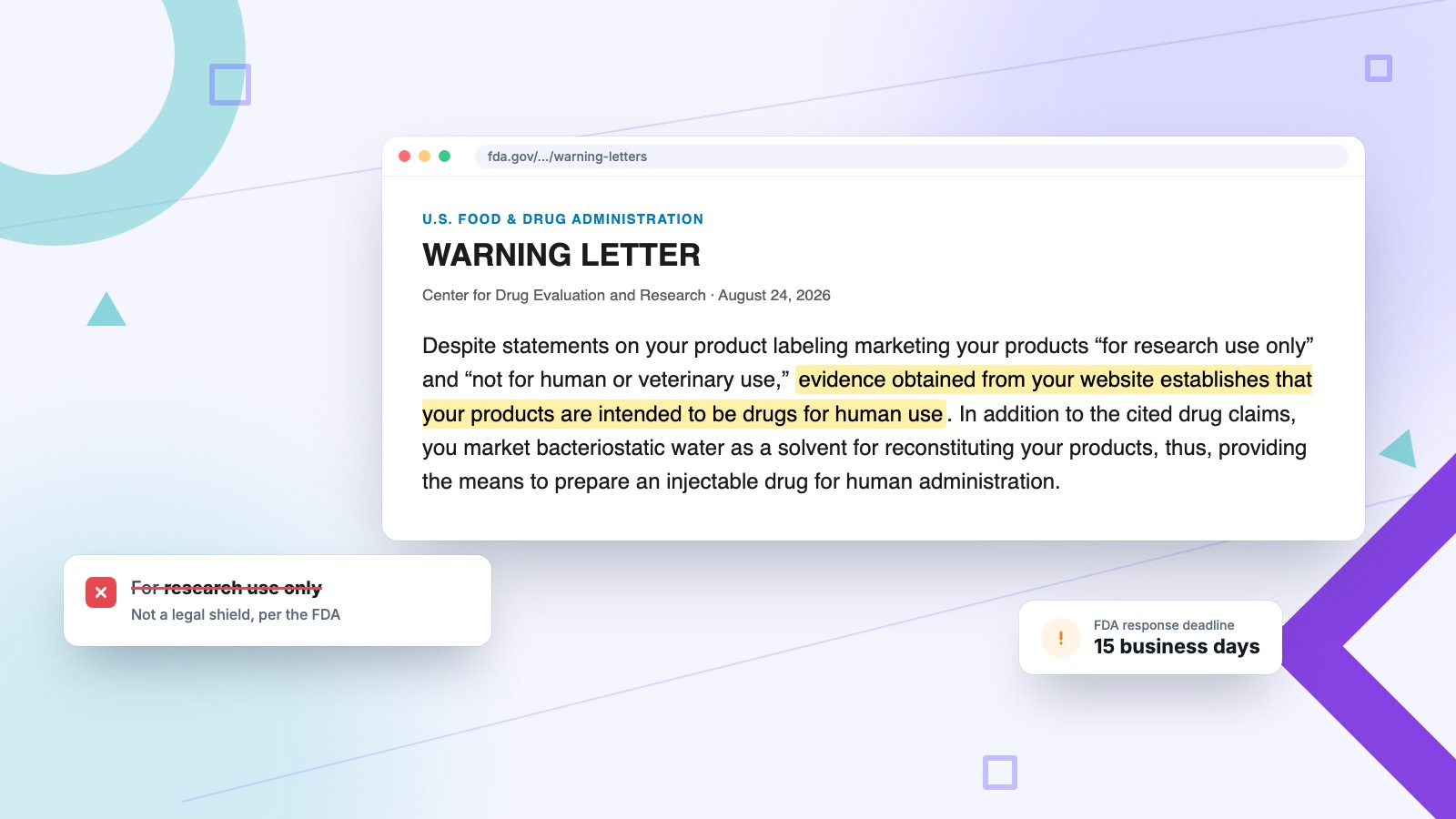
The August 24, 2026 letters say it the same way. The letter to Peptide Partners notes the “research use only” labeling, then says “evidence obtained from your website establishes that your products are intended to be drugs for human use,” and concludes “these products are unapproved new drugs.” Law firm ArentFox Schiff titled its summary of that batch “Five Peptide Vendors Learn That ‘Research Use Only’ Is Not a Legal Strategy”, and put it bluntly: “The RUO label is not protection.”
What gets peptide sellers an FDA warning letter?
Website content that points to human use: health claims in product copy, bacteriostatic water sold alongside vials, and dosing or reconstitution calculators.
The evidence the FDA cites in these letters is specific, and most of it is ordinary website content:
- Study summaries that describe effects on the body. The Peak Performance Peptides letter quotes product copy like “Studied for effects on insulin secretion and glycemic control.” Copy written as research summaries still counts as a drug claim.
- Bacteriostatic water next to the peptides. The Peptide Partners letter says the store marketed “bacteriostatic water as a solvent for reconstituting your products,” which provides the means to prepare an injectable drug for human administration.
- A peptide calculator. The NuScience Peptides letter calls out bacteriostatic water sold “alongside a ‘peptide calculator,'” and lists the BAC water itself as an unapproved new drug.
- Code names don’t help. The same NuScience letter lists products named “GLP-1 Sema Research Peptide” and “GLP-2 Tirz Peptide.” Renaming a compound doesn’t change what it is.
Each letter gives the company fifteen business days to respond with the steps it has taken, and warns that failing to fix the violations “may result in regulatory or legal action without further notice including, without limitation, seizure and injunction.”
This matches what we see from the hosting side. The complaints that reach our clients’ servers name a specific compound and the product pages selling it, so they follow the compound, not the product name. Retatrutide, one of the compounds in these letters, draws the most attention, and ArentFox Schiff notes that “Retatrutide cannot lawfully be compounded under Section 503A.”
What did the October 2026 HHS peptide policy change?
HHS said it won’t act against licensed pharmacies compounding six peptides for patients with prescriptions. It explicitly does not cover research-use-only sellers.
On October 28, 2026, HHS published an enforcement discretion policy in the Federal Register covering six peptides: BPC-157, Epitalon, KPV, MOTS-c, Semax and TB-500. According to Holland & Knight’s summary, HHS “does not intend to take action against a state-licensed pharmacy, federal facility or licensed physician” compounding one of them when all 10 conditions are met. Those include a patient-specific prescription, an ingredient from an FDA-registered manufacturer and a certificate of analysis.
That’s real news for peptide clinics. For online research stores, it changes nothing. The same summary is clear that “the Policy does not extend to research-use-only API,” and says one goal is to “discourage the continued, widespread use of certain peptides often labeled as ‘research use only.'” The policy is also interim: it “has no formal effect of law,” the six peptides still aren’t on the FDA’s bulk substances list, and HHS is taking public comments under docket HHS-OASH-2026-0496 through November 13, 2026. STAT covered the announcement the day it came out.
If you’re thinking about opening a clinic instead of a store, that’s a different business with a different website. Our founder, Jacob Wonder, covers how the two builds differ in his notes on peptide website design.
Can you get in trouble for selling peptides?
Yes. Beyond FDA warning letters, sellers face drugmaker complaints and lawsuits, plus processors and hosts that drop them first.
The FDA is only one of the parties watching. ArentFox Schiff reports that one drugmaker has referred “more than 200 entities to the FDA, US Department of Justice (DOJ), state attorneys general, and licensing boards,” and has filed federal lawsuits of its own. Brand-protection firms working for drugmakers also file abuse complaints with the companies your store depends on: your web host, your CDN and your domain registrar.
In practice, those business consequences usually arrive before any legal ones. We’ve handled many brand-protection complaints for the peptide stores we host. None has gotten a store shut off, but providers usually give 24 to 48 hours to respond, and when a move is needed we’ve done most of them within an hour.
Payment processors are stricter still. Stripe’s restricted businesses list prohibits “incorrectly labeled research chemicals.” We cover the hosting and payment side in detail in our guide to selling peptides online.
Is it illegal to sell peptides online?
Selling online doesn’t change the law, but it puts your evidence in public. Your product pages are exactly what the FDA reads.
Every letter above was built from a review of the seller’s website. That’s the part of your business we work on, and it’s also the part you control most. The same pages get read by payment processors before they approve you and by ad platforms before they run your ads (our post on peptide ads covers what Meta, Google and TikTok allow). A product page that would worry the FDA will usually fail all three reviews.
How do peptide sellers lower their legal risk?
Get a regulatory attorney first. Then remove human-use signals from the website: no health claims, no dosing, no reconstitution tools, no bundled bacteriostatic water.
None of this makes an unapproved drug legal, and an attorney should decide what you sell. But these are the website changes that line up with what the FDA letters cite, and they’re the same things processors ask our clients for:
- Rewrite product copy so it describes the compound (chemistry, purity, lab report) without describing effects on the body, even in study-summary form.
- Remove dosing charts, reconstitution guides and peptide calculators.
- Don’t sell bacteriostatic water, syringes or “kits” alongside the vials. One of the stores we manage switched off its bacteriostatic water upsell as a compliance step.
- Keep a “research use only, not for human consumption” notice on every product page and a required research-use checkbox at checkout. It won’t protect you on its own, but processors require it.
- Add a 21+ age confirmation, real contact details and complete refund, shipping and terms pages.
- Publish a certificate of analysis for every product.
- Check your blog, emails and social posts too. They count as “advertising matter” under the intended use rule.
Then plan for the business side: a backup payment processor and hosting that can move your store in hours. Our guide on how to start a peptide business walks through the full setup, with a profit calculator that includes processor fees and reserves.
Frequently asked questions
Is BPC-157 legal now?
Only through compounding. Since October 28, 2026, HHS has said it won’t act against state-licensed pharmacies and physicians compounding BPC-157 for a patient with a prescription, under 10 conditions. The policy doesn’t cover research-use-only sellers, and BPC-157 is still not an FDA-approved drug.
Do you need a license to sell peptides?
There’s no license that makes selling unapproved peptides for human use legal. Approved peptide drugs are dispensed by licensed pharmacies with a prescription, and compounding requires a state-licensed pharmacy or physician. Research-use sellers don’t hold a license for it, which is why their websites get scrutinized.
Is it legal to buy peptides online?
The FDA’s actions target sellers, not buyers. It does urge consumers not to buy peptides labeled “for research purposes” because they’re of unknown quality, and to buy medicines only from state-licensed pharmacies.
Does renaming a peptide make it legal to sell?
No. FDA letters list products under code names like “GLP-1 Sema Research Peptide” and still call them unapproved new drugs. Brand-protection complaints work the same way: they follow the compound, not the product name.
Will a web host take down a peptide store?
Many will after a complaint, because their acceptable use policies give them broad discretion. Providers usually give 24 to 48 hours’ notice. We host peptide stores on a $50 a month plan that’s built to move a store quickly when that happens.
The short version
Selling approved peptide drugs by prescription is legal, and six peptides can now be compounded for patients under HHS’s interim policy. Selling unapproved peptides online for human use is not legal, and a “research use only” label won’t save a website that shows human use. The FDA reads your product pages, add-ons and tools, so review those with an attorney first.
We build, host and maintain websites for peptide businesses, including the compliance pages processors ask for and hosting that can move a store fast. Tell us about your store, or call us at (919) 444-2005.